
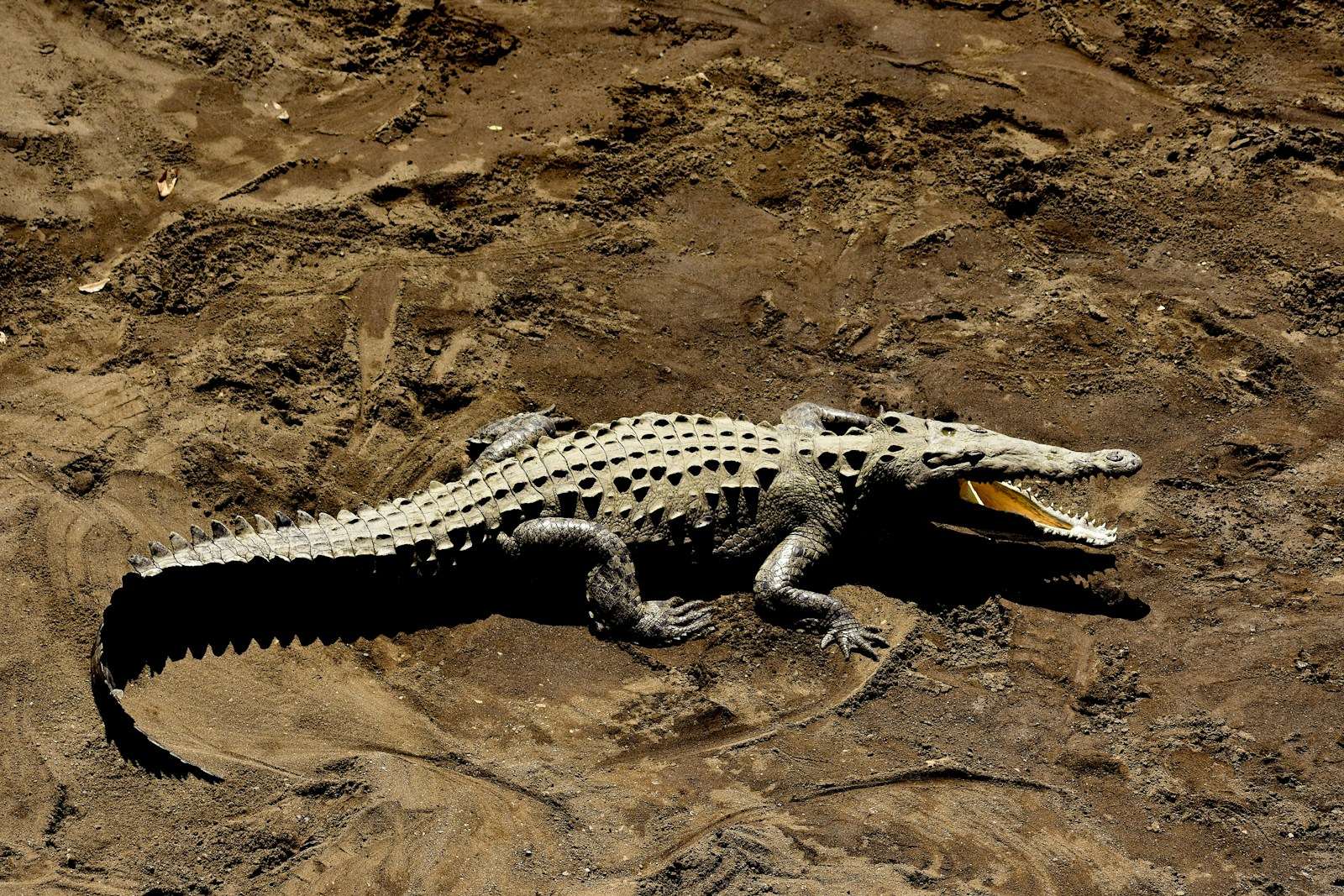
Costa Rica's crocodile bridge is the Route 34 bridge over the Tárcoles River, about an hour to an hour and a quarter from the San José airport on the coast road to Jacó and Manuel Antonio. It's free, it has railed walkways on both sides, and from the middle you look straight down on American crocodiles lying out on the mud banks.
Stop. It costs ten minutes and you'll talk about it for the rest of the trip. If you have a morning to spare on the same drive, the boat trip that runs on the river below is the version that gets you to water level, with a guide and the birds that make the estuary worth a second look.
This page contains affiliate links. iTravelCostaRica may earn a commission if you book through these links, at no additional cost to you.
A free stop on the main road to the Pacific
Route 34, the Costanera Sur, is the coast highway almost everyone takes from San José to the central and southern Pacific, and the Tárcoles bridge sits right on it. Coming from the airport it's roughly an hour to an hour and a quarter, depending on traffic. Jacó is about 20 to 30 minutes further south, and Manuel Antonio about an hour and a half. If you're staying in Jacó, it's an easy short trip north, and it pairs naturally with Carara National Park next door, which the Jacó travel guide covers.
Both sides of the bridge now have walkways with railings, separated from the traffic, so you're not edging along a road shoulder to look over the side. Most of the crocodiles are visible from the middle of the span. A typical stop takes ten to fifteen minutes, which is why it works so well on a transfer day: it breaks up the drive without costing you the afternoon.
What you see from the railing
The animals below are American crocodiles, not alligators, and the Tárcoles holds them in unusual numbers. The big ones are genuinely big: the operator of the boat trip on this river describes some past four metres. From the bridge you're looking down from roughly 30 to 40 feet, at crocodiles lying on the sandbars and mud banks or drifting just under the surface, so a pair of binoculars or a zoom lens turns a good view into a detailed one.
Guides to the bridge suggest coming at low tide, when more of the bank is exposed, and early or late in the day, when the animals are more active. Crocodiles are there at every hour, though, so don't rearrange a drive around the tide. Stop when the road brings you to it.
How to stop without losing your bags
The bridge itself is safe. The car you left beside it is the part to think about, because break-ins at this stop have been common, even if police presence has improved things. A few habits cover it:
- Park where someone is watching. There's a cluster of small restaurants and shops at the bridge, plus pull-offs at either end. Parking is free, and there is often an attendant who will keep an eye on cars for a tip of about a dollar, which is worth paying.
- Leave nothing visible. If your luggage is in the car on a transfer day, take turns: one person walks out while the other stays with the car.
- Hold small children's hands. The gaps between the railings are wide enough for a young child to slip through.
- Bring a hat and water. There's no shade on the bridge, and the Pacific lowlands are hot by mid-morning.
- Stay on the bridge. Never climb down to the riverbank for a closer photo. People have been seriously injured and killed doing exactly that.
When the boat trip is worth adding
The bridge shows you crocodiles from above. The boat shows you the river. It follows the lower river past the riverbanks and mangroves below Carara, where herons, egrets, kingfishers and roseate spoonbills feed along the banks, and the birds are at least half the reason to go. You see the crocodiles at water level rather than from a highway, with a guide explaining what you're looking at.
The trip sold on this site is run by Jungle Crocodile Safari from its own dock in Tárcoles village, and the listing sets out the terms plainly:
- Price: $40 for adults, which on this listing means age 13 and up, and $30 for children from 4 to 12. Infants under 4 aren't charged.
- Length and times: 105 minutes on the river, with departures at 8:30 a.m., 10:30 a.m., 1:30 p.m. and 3:30 p.m., every day.
- Guiding: a bilingual guide with live commentary, plus a bird guide.
- Travelling alone: the booking accepts a single person, but the operator's own notes say a departure runs with a minimum of two. If yours does not fill, you are offered the trip on your own at a higher rate or a full refund, so check with the operator before building a solo day around it.
- Getting there: transport isn't included, so it suits a rental car or a private transfer that can stop on the way.
- Cancellation: a full refund if you cancel at least 24 hours before your departure.
- Access: the listing states wheelchair-accessible facilities. Ask the operator about boarding the boat itself before you go.
The departure to choose depends on your day. The 8:30 a.m. trip is the one for birds and soft light, and it leaves the whole day free afterwards, so you can be on the beach in Jacó by lunch. The 3:30 p.m. trip is the other good slot if you're coming from the south. The two middle departures are the hottest and brightest on open water. Booking ahead puts your place and the cancellation terms in writing, which is useful on a travel day when a late flight or a slow road can move everything.
The one thing to avoid: anyone who feeds them
Feeding wild crocodiles is illegal in Costa Rica. It changes how the animals hunt, it draws them toward people, and it puts guides and passengers at real risk. Some boats on the Tárcoles have done it anyway: complaints have gone to local prosecutors, and in 2022 the national parks agency, SINAC, announced an inspection to sanction it. Whichever boat you're on, if a guide offers to bring a crocodile closer with food, that's the moment to say no. A good guide doesn't need bait to find crocodiles on this river.
For a wider view of where the country's wildlife is easiest to see, and how the Tárcoles boat compares with the rainforest tours, read the guide to Costa Rica wildlife tours.
Questions people ask
Are there crocodiles in Costa Rica?
Is the crocodile bridge free?
How long should you stop?
Is it safe to stop at the crocodile bridge?
Do you need a tour to see the crocodiles?
Put it on the drive, not on a day of its own
The crocodile bridge earns its fame because it costs nothing and sits exactly where you'll already be driving. Stop on the way to the coast, every time. If your arrival day has a free morning, or you're heading back to San José with time before a flight, take the 8:30 a.m. boat as well and turn a long transfer into the wildlife hour of the trip. For the rest of the coast it sits on, the Central Pacific coast guide picks up where the bridge leaves off.